
Validation & Regulated IT Support
Risk-based validation and regulated IT support for life sciences and healthcare environments where quality, data integrity, and audit readiness matter.

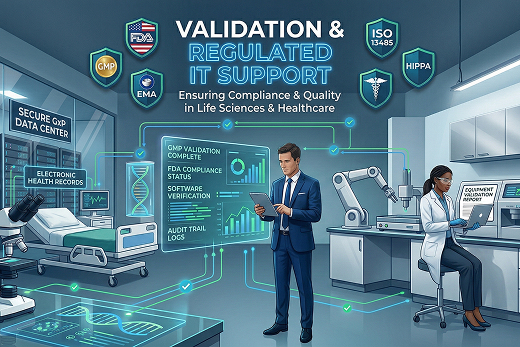
Delivery Model
Validation and IT Support for High-Trust, Regulated Environments
In life sciences and healthcare, technology systems often sit inside workflows where product quality, patient safety, data integrity, and regulatory defensibility matter. That means implementation and support cannot stop at technical functionality alone. Systems need to be validated, changes need to be controlled, users and access need to be governed, and supporting records need to stand up to review.
IQA helps organizations validate and support regulated IT environments across the full system lifecycle, from planning and risk assessment through testing, release, change control, ongoing support, and periodic review. The goal is not documentation for its own sake. It is to help organizations maintain systems in a fit-for-purpose, controlled, and audit-ready state. This is consistent with how current regulations frame computerized systems: ICH E6(R3) requires risk-based validation throughout the lifecycle for clinical systems; EU GMP Annex 11 requires the application to be validated and IT infrastructure to be qualified; and 21 CFR Part 11 sets requirements for electronic records and signatures used under applicable FDA record requirements.
What We Enable
What IQA Supports Across Validation and Regulated IT
Validation Strategy and Planning
Define fit-for-purpose validation approaches based on intended use, system criticality, data importance, and business or regulatory impact.
CSV and CSA-Oriented Validation Support
Support risk-based validation activities across computerized systems, with proportionate rigor based on system use and risk. Where applicable, this can include CSA-style approaches for production or quality system software in medical device environments.
Requirements, Testing, and Traceability
Support user requirements, functional understanding, test planning, traceability, evidence capture, and documentation needed to demonstrate system fitness for use.
Change Control and Release Validation
Help organizations manage validated changes through impact assessment, testing, release readiness, and documented change control.
Regulated IT Support and Issue Management
Provide support for incidents, defects, deviations, escalations, and recurring issues in systems that need to remain controlled over time.
Periodic Review and Lifecycle Maintenance
Support ongoing review to help systems remain in a validated state throughout their lifecycle, including updates, integrations, and operational changes.
The Environments We Help Validate and Support
Clinical Trial Systems
- EDC, CTMS, ePRO, randomization, endpoint capture, safety-related workflows, and connected clinical systems where data reliability and participant protection matter. ICH E6(R3) specifically requires risk-based validation of computerized systems used in clinical trials and says interfaces between systems should also be defined and validated.
Regulatory and Quality Systems
- Systems supporting submission workflows, document control, review processes, CAPA, deviations, and quality management operations.
Manufacturing, Lab, and GMP Systems
- Applications and infrastructure supporting GMP-regulated activities, labs, production, and quality operations where Annex 11 applies and the application should be validated while infrastructure should be qualified.
Medical Device Production and QMS Software
- Production and quality management system software where FDA’s CSA guidance recommends a risk-based approach to establish confidence in automation and choose appropriate assurance activities.
Cloud and Hybrid GxP Environments
- Validated systems and supporting environments operating in cloud, hybrid, or modern delivery models where compliance, security, and lifecycle control must remain intact. Industry guidance from KPMG notes that DevOps can support shorter validation cycles when compliance and security are addressed early.
Connected and Integrated Platforms
- Systems with APIs, interfaces, third-party services, and multi-platform workflows that need controlled integration, validated data exchange, and supplier/service-provider oversight. Annex 11 explicitly requires formal agreements and clear responsibilities for suppliers and service providers, with audit needs based on risk.
Core Validation and Regulated IT Support Services
Built Around Current Regulatory and Industry Expectations
Validation and regulated IT support should reflect the realities of today’s regulatory environment, not only legacy documentation habits.
That means supporting expectations such as:
Technology-Agnostic and Lifecycle-Driven
IQA is technology-agnostic. We support validation and regulated IT operations within the client’s existing platforms, cloud strategy, hosting model, SDLC, DevOps practices, vendor ecosystem, and quality framework.
The goal is not to force a validation template or one-size-fits-all model. It is to apply the right level of control, evidence, and operational support for the system and the environment it serves. This is also where industry need is shifting: providers increasingly position validation around faster cycles, stronger traceability, and fit-for-purpose assurance rather than purely document-heavy legacy CSV.
That can include:
Why Validation and Regulated IT Support Matter More Now
Life sciences and healthcare organizations are modernizing platforms, moving into cloud and hybrid environments, increasing automation, and introducing more analytics and AI into operational workflows. At the same time, regulatory expectations remain focused on control, documentation, data integrity, and system fitness for intended use.
This is the same market need reflected across leading providers: modernization, cloud adoption, AI-enabled operations, and faster release cycles all increase the need for smarter, risk-based quality and compliance support.
Validation and regulated IT support matter more now because they help organizations:
Why IQA for Validation & Regulated IT Support
Built for Regulated Life Sciences and Healthcare Environments
We understand the system controls, traceability, and quality expectations that shape clinical, regulatory, quality, manufacturing, and connected digital environments.
Risk-Based and Practical by Design
We align validation rigor to intended use, risk, and data importance rather than applying unnecessary effort uniformly. This aligns with ICH E6(R3), Annex 11, and FDA CSA.
Connected to Real Delivery Models
We support validation and regulated IT needs across implementation, release, change control, ongoing support, and periodic review-not only at initial go-live.
Technology-Agnostic Delivery
We work within the client's existing platform, cloud, vendor, and SDLC environment.
Built for Audit Readiness and Operational Continuity
Our approach helps organizations maintain systems that are controlled, usable, reviewable, and supportable over time.
Support Regulated Systems with Greater Confidence
Explore how IQA helps life sciences and healthcare organizations validate systems, manage regulated IT operations, and maintain high-trust environments across the full system lifecycle.